Download files
Date
02/11/2022Tags
Photos
About
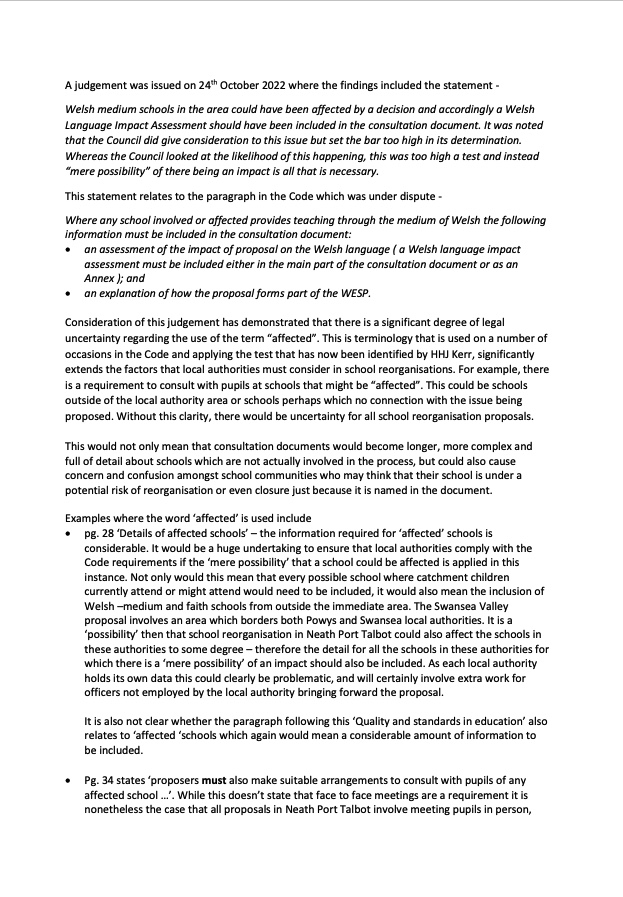
A judgement was issued on 24th October 2022 where the findings included the statement – Welsh medium schools in the area could have been affected by a decision and accordingly a Welsh Language Impact Assessment should have been included in the consultation document. It was noted that the Council did give consideration to this issue but set the bar too high in its determination. Whereas the Council looked at the likelihood of this happening, this was too high a test and instead “mere possibility” of there being an impact is all that is necessary. This statement relates to the paragraph in the Code which was under dispute – Where any school involved or affected provides teaching through the medium of Welsh the following information must be included in the consultation document:- an assessment of the impact of proposal on the Welsh language ( a Welsh language impact assessment must be included either in the main part of the consultation document or as an Annex ); and
- an explanation of how the proposal forms part of the WESP.
Consideration of this judgement has demonstrated that there is a significant degree of legal uncertainty regarding the use of the term “affected”. This is terminology that is used on a number of occasions in the Code and applying the test that has now been identified by HHJ Kerr, significantly extends the factors that local authorities must consider in school reorganisations. For example, there is a requirement to consult with pupils at schools that might be “affected”. This could be schools outside of the local authority area or schools perhaps which no connection with the issue being proposed. Without this clarity, there would be uncertainty for all school reorganisation proposals.This would not only mean that consultation documents would become longer, more complex and full of detail about schools which are not actually involved in the process, but could also cause concern and confusion amongst school communities who may think that their school is under a potential risk of reorganisation or even closure just because it is named in the document. Examples where the word ‘affected’ is used include- pg. 28 ‘Details of affected schools’ – the information required for ‘affected’ schools is considerable. It would be a huge undertaking to ensure that local authorities comply with the Code requirements if the ‘mere possibility’ that a school could be affected is applied in this instance. Not only would this mean that every possible school where catchment children currently attend or might attend would need to be included, it would also mean the inclusion of Welsh –medium and faith schools from outside the immediate area. The Swansea Valley proposal involves an area which borders both Powys and Swansea local authorities. It is a ‘possibility’ then that school reorganisation in Neath Port Talbot could also affect the schools in these authorities to some degree – therefore the detail for all the schools in these authorities for which there is a ‘mere possibility’ of an impact should also be included. As each local authority holds its own data this could clearly be problematic, and will certainly involve extra work for officers not employed by the local authority bringing forward the proposal. It is also not clear whether the paragraph following this ‘Quality and standards in education’ also relates to ‘affected ‘schools which again would mean a considerable amount of information to be included.
- Pg. 34 states ‘proposers must also make suitable arrangements to consult with pupils of any affected school …’. While this doesn’t state that face to face meetings are a requirement it is nonetheless the case that all proposals in Neath Port Talbot involve meeting pupils in person,
giving them the first hand opportunity to ask and answer questions in a way which best suits the age and ability of the children or young people involved, without relying on the ability of pupils to produce written responses. Again the use of the word affected, if interpreted as ‘mere possibility’ of an impact, would mean many pupil consultations would need to be conducted, which again has huge workload implications and would surely not be in keeping with what is actually required. While it would seem unlikely that this is what the Code requires, it is the case nonetheless that following this judgement would mean that even if there is a ‘mere possibility’ that a school could be affected by a proposal then everything should be included in the document, to adhere to the Code and to avoid any possibility of future challenge.